

-
This forum contains old posts that have been closed. New threads and replies may not be made here. Please navigate to the relevant forum to create a new thread or post a reply.
You are using an out of date browser. It may not display this or other websites correctly.
You should upgrade or use an alternative browser.
You should upgrade or use an alternative browser.
Brahma Sutras
- Thread starter sravna
- Start date
- Status
- Not open for further replies.
OP
OP

Provided you do not "escape" by then..Sravna..you are quite infamous for starting a thread get into the depth of it and then suddenly "ESCAPE" saying that you have some urgent matter to look into..this time you better not run away like that!LOL
Actually Renuka, this forum is my escape. see you are getting it reversed again?

Actually Renuka, this forum is my escape. see you are getting it reversed again?
Sravna, I actually deleted that post I wrote cos I could not find the post of yours which I quoted...did you delete that post?
Dear Nara ji,
I did not email Samskrita Bharati New Delhi yet but I managed to find this online about Ramanuja's commentary on One's own Dharma = Karma Yoga and Anothers Dharma = Jnana Yoga
śreyān sva-dharmo viguṇaḥ para-dharmāt svanuṣṭhitāt |
sva-dharme nidhanaṃ śreyaḥ para-dharmo bhayāvaḥ || 35 ||
35. Better is one's own duty, though devoid of merit, than the duty of another well-done. Better is
death in one's own duty; the duty of another is fraught with fear.
Commentary
Therefore Karma Yoga [one’s own natural duty] is better than Jñāna Yoga [the duty of
another]. It is one's personal duty because it is natural and easy to perform, and even if
defective, it is free from possibility of interruption and fall. Jñāna Yoga (meditation on the
ātman), on the other hand, though performed well for some time, constitutes an alien duty, as it
is difficult to practice for one immersed in Material Nature. It is therefore subject to
interruption and the possibility of error. For a Karma Yogi — practicing his natural duty,
even death without success in one birth does not matter. In the next birth, with the help of the
experience already gained in this birth it will be possible to perform Karma Yoga without any
impediments.
http://www.srimatham.com/uploads/5/5/4/9/5549439/ramanuja_gita_bhashya.pdf
I did not email Samskrita Bharati New Delhi yet but I managed to find this online about Ramanuja's commentary on One's own Dharma = Karma Yoga and Anothers Dharma = Jnana Yoga
śreyān sva-dharmo viguṇaḥ para-dharmāt svanuṣṭhitāt |
sva-dharme nidhanaṃ śreyaḥ para-dharmo bhayāvaḥ || 35 ||
35. Better is one's own duty, though devoid of merit, than the duty of another well-done. Better is
death in one's own duty; the duty of another is fraught with fear.
Commentary
Therefore Karma Yoga [one’s own natural duty] is better than Jñāna Yoga [the duty of
another]. It is one's personal duty because it is natural and easy to perform, and even if
defective, it is free from possibility of interruption and fall. Jñāna Yoga (meditation on the
ātman), on the other hand, though performed well for some time, constitutes an alien duty, as it
is difficult to practice for one immersed in Material Nature. It is therefore subject to
interruption and the possibility of error. For a Karma Yogi — practicing his natural duty,
even death without success in one birth does not matter. In the next birth, with the help of the
experience already gained in this birth it will be possible to perform Karma Yoga without any
impediments.
http://www.srimatham.com/uploads/5/5/4/9/5549439/ramanuja_gita_bhashya.pdf
Last edited:

Vaagmi
0
Nara,
Your post #206 for reference:
You have credited me with the adjective "illustrious" and I want to live up to your judgment
1) There is no problem for me in accepting that Vedanta is Hindu philosophy (rather I am proud of that) and so is religious. I do not know about others views on this. But when I speak about epistemology, it is epistemology that is discussed in Vedanta. Vedanta minus SrimanNarayana or simply God can be a common ancient scripture of any religion in existence today. Christianity and Islam can own it. Only when an attempt is made to brand it(as you have done) with the tag called ‘religious text’ in which the word religion stands for a dogmatic or theological categorization, I disagree with you. If you read any Upanishad after removing whatever name of God is there in it you will realize the truth of what I say. The rest of your accusations about me being ashamed of my religion etc., I am leaving as just an outburst.
2) If these texts present this knowledge in a very clear way, why then there is there so much quarrel about what it really means? These people have been squabbling among themselves for centuries and there is no sign of this abating, and the view they subscribe to is always that of their parents, with very few exceptions. Sounds like religion!! --these are your words.
It is clear to me while it is not clear to you and so we are arguing. Is it not so? It is like two advocates taking a dispute over the ‘right to preemption’ up to supreme court(in the preindependence era they used to go by ship to London to argue the case even in privy council). They spend a lot of their valuable time pouring over law books, past history of judgments, facts in hand etc. and keep arguing for years endlessly. In the process sometime one advocate may even die and still the case will continue to be argued by others. That is the human nature. This fact does not reduce the importance or relevance of the matter in dispute.
3) Many of these ancestors themselves did not agree with each other about this metaphysics. There were several ஆஸ்திக மதம் as well as நாஸ்திக மதம். Whom among these an aspiring student full of intent, dedication, obedience, and all the wonderful prerequisites must turn to for true knowledge, an Advaitin, VA, Sankhya perhaps, or Charvaka? –your words again:
The aspiring student should study all that is available - advaitam, VA, Sankhya, Charvaka and every other branch that is available - and finally think about all that he has studied and reach his own conclusions. That is the process of knowledge acquisition. I am surprised that you have asked this question.
4) It is claimed that Vedanta does not preach but teaches. This is the claim of all religious people. Bible is supposed to teach, Kuran is the best teacher there is. Also, how can one claim Vedanta does not preach? It makes so many demonstrably irrational and absurd claims that one can believe in them only on blind faith and that makes these claims nothing but preachings. Your words.
a)There was a time when the pratyaksha source of knowledge was depended upon to conclude that earth is flat. Later the same source found out that it is spherical in shape.
b)Similarly the pratyaksha and anumana sources of knowledge and reason were used to say that genes are the basic building block of all living beings. We have been using the genes to determine even the parentage of people. But recently scientists have found out that a living being can have genes of several ancestors all at the same time. Now people are trying to rewrite genetics.
c)Once we were having an axiomatic principle with which we built our geometry which said the shortest distance between two dots on a plane is a straight line. Now we all know that it is not a straight line.
So what was rational yesterday has become irrational today. What is rational today may become irrational in a hundred years. Did science teaching all these years involved preaching? If science which keeps changing its position with time was teaching, Vedanta is also teaching of a different kind. Now you have to tell me what are the absurd claims that have been made in Vedanta.
5) And then they protest, but these are subjective matters, there is no possibility for empirical proof in metaphysics. Well, then, the only rational position to take is an agnostic one. In the absence of empirical proof hold your horses, don't let is race away with a multitude of assertions equal in certainty as 2 + 3 is 5. If you do, like the Vedic texts do, then it is religion we are talking about. –your words.
There are certain ultimate metaphysical questions to which empirical thought can offer no decisive answer. The fundamental question of that kind is about the existence of God. Empirical intelligence can offer no conclusive proof for the existence of God or for the non-existence of God. The significance of this impasse is that the idea of God is neither to be based on empirical reason nor to be discredited on that ground. Reason is powerless to prove and equally powerless to disprove. This philosophical position is what Immanuel Kant had brought out at the end of his Critique of Pure Reason. This is a proof of the limitations of the empirical intelligence and the pure reason seeking to discover reality by its own light. If you want to call this impasse by the name agnosticism it is ok with me.
6)There are only three sources of true knowledge, (i) direct observation, (ii) rational argument free of fallacies, and (iii) accumulated verified knowledge. Metaphysics must also operate within the confines of this epistemological limits. Anything that is based on what you guys have argued is by definition outside these limits and therefore, Vedantam is religion and nothing other than religion --your words:
As there is no dispute about i) and ii) let us take the iii). It is my contention that vedanta belongs to the third category more eminently than all the so called accumulated and verified empirical knowledge which you are arguing for. We are seeing every day how all these accumulated and verified scientific empirical knowledge is getting discredited and is being replaced by another set of verified knowledge. So taking a view from a higher level all these phenomenal knowledge or knowledge relative to time are not knowledge at all. Vedanta which is intuited knowledge is real knowledge. That takes us to intuition which is a subject in itself.
This subject is such that it needs a long and involved discussion which is not possible here. So only this much can be said here.
If your pramana called சப்தம் is science, my pramana called சப்தம் is Vedanta. I believe that thought when it is pure is in rapport with reality. This is the basis of all knowing and all apprehension of reality. All knowledge is intrinsically valid. No adventitious support or evidence , no alien quality of excellence is needed to invest knowledge with truth. Please think about it.
Your post #206 for reference:
You have credited me with the adjective "illustrious" and I want to live up to your judgment
1) There is no problem for me in accepting that Vedanta is Hindu philosophy (rather I am proud of that) and so is religious. I do not know about others views on this. But when I speak about epistemology, it is epistemology that is discussed in Vedanta. Vedanta minus SrimanNarayana or simply God can be a common ancient scripture of any religion in existence today. Christianity and Islam can own it. Only when an attempt is made to brand it(as you have done) with the tag called ‘religious text’ in which the word religion stands for a dogmatic or theological categorization, I disagree with you. If you read any Upanishad after removing whatever name of God is there in it you will realize the truth of what I say. The rest of your accusations about me being ashamed of my religion etc., I am leaving as just an outburst.
2) If these texts present this knowledge in a very clear way, why then there is there so much quarrel about what it really means? These people have been squabbling among themselves for centuries and there is no sign of this abating, and the view they subscribe to is always that of their parents, with very few exceptions. Sounds like religion!! --these are your words.
It is clear to me while it is not clear to you and so we are arguing. Is it not so? It is like two advocates taking a dispute over the ‘right to preemption’ up to supreme court(in the preindependence era they used to go by ship to London to argue the case even in privy council). They spend a lot of their valuable time pouring over law books, past history of judgments, facts in hand etc. and keep arguing for years endlessly. In the process sometime one advocate may even die and still the case will continue to be argued by others. That is the human nature. This fact does not reduce the importance or relevance of the matter in dispute.
3) Many of these ancestors themselves did not agree with each other about this metaphysics. There were several ஆஸ்திக மதம் as well as நாஸ்திக மதம். Whom among these an aspiring student full of intent, dedication, obedience, and all the wonderful prerequisites must turn to for true knowledge, an Advaitin, VA, Sankhya perhaps, or Charvaka? –your words again:
The aspiring student should study all that is available - advaitam, VA, Sankhya, Charvaka and every other branch that is available - and finally think about all that he has studied and reach his own conclusions. That is the process of knowledge acquisition. I am surprised that you have asked this question.
4) It is claimed that Vedanta does not preach but teaches. This is the claim of all religious people. Bible is supposed to teach, Kuran is the best teacher there is. Also, how can one claim Vedanta does not preach? It makes so many demonstrably irrational and absurd claims that one can believe in them only on blind faith and that makes these claims nothing but preachings. Your words.
a)There was a time when the pratyaksha source of knowledge was depended upon to conclude that earth is flat. Later the same source found out that it is spherical in shape.
b)Similarly the pratyaksha and anumana sources of knowledge and reason were used to say that genes are the basic building block of all living beings. We have been using the genes to determine even the parentage of people. But recently scientists have found out that a living being can have genes of several ancestors all at the same time. Now people are trying to rewrite genetics.
c)Once we were having an axiomatic principle with which we built our geometry which said the shortest distance between two dots on a plane is a straight line. Now we all know that it is not a straight line.
So what was rational yesterday has become irrational today. What is rational today may become irrational in a hundred years. Did science teaching all these years involved preaching? If science which keeps changing its position with time was teaching, Vedanta is also teaching of a different kind. Now you have to tell me what are the absurd claims that have been made in Vedanta.
5) And then they protest, but these are subjective matters, there is no possibility for empirical proof in metaphysics. Well, then, the only rational position to take is an agnostic one. In the absence of empirical proof hold your horses, don't let is race away with a multitude of assertions equal in certainty as 2 + 3 is 5. If you do, like the Vedic texts do, then it is religion we are talking about. –your words.
There are certain ultimate metaphysical questions to which empirical thought can offer no decisive answer. The fundamental question of that kind is about the existence of God. Empirical intelligence can offer no conclusive proof for the existence of God or for the non-existence of God. The significance of this impasse is that the idea of God is neither to be based on empirical reason nor to be discredited on that ground. Reason is powerless to prove and equally powerless to disprove. This philosophical position is what Immanuel Kant had brought out at the end of his Critique of Pure Reason. This is a proof of the limitations of the empirical intelligence and the pure reason seeking to discover reality by its own light. If you want to call this impasse by the name agnosticism it is ok with me.
6)There are only three sources of true knowledge, (i) direct observation, (ii) rational argument free of fallacies, and (iii) accumulated verified knowledge. Metaphysics must also operate within the confines of this epistemological limits. Anything that is based on what you guys have argued is by definition outside these limits and therefore, Vedantam is religion and nothing other than religion --your words:
As there is no dispute about i) and ii) let us take the iii). It is my contention that vedanta belongs to the third category more eminently than all the so called accumulated and verified empirical knowledge which you are arguing for. We are seeing every day how all these accumulated and verified scientific empirical knowledge is getting discredited and is being replaced by another set of verified knowledge. So taking a view from a higher level all these phenomenal knowledge or knowledge relative to time are not knowledge at all. Vedanta which is intuited knowledge is real knowledge. That takes us to intuition which is a subject in itself.
This subject is such that it needs a long and involved discussion which is not possible here. So only this much can be said here.
If your pramana called சப்தம் is science, my pramana called சப்தம் is Vedanta. I believe that thought when it is pure is in rapport with reality. This is the basis of all knowing and all apprehension of reality. All knowledge is intrinsically valid. No adventitious support or evidence , no alien quality of excellence is needed to invest knowledge with truth. Please think about it.
Last edited:
sangom
0
< snipped >
If Vedanta is not religion then what is it? It is Metaphysics is probably the answer we are likely to get. But metaphysical questions have been the foundation upon which all religions are built. The Christians have their metaphysics, the Muslims have theirs, the Zoroastrians have theirs, etc. So, just saying it is metaphysics does not make it a non-religious text.
< snipped >
I think religions are not, in general, built upon metaphysical questions, i.e., questions regarding the fundamental nature of "being" and of this world/universe.
For instance, the early people who were believers in the Vedas, seem to have deified certain forces of nature and some natural phenomena and, as was perhaps a very ancient custom, tried to "propitiate" these deities with the unique juice of the soma plant and by sacrificing various animals - i.e., killing these animals as part of their religious ritual, offering the "omentum" or vapA (belly's fat layers) as oblation/s in a sacrificial fire and consuming the more edible parts of these animals themselves as part of the religious rite/s. At that stage of living, it does not appear as though the priesthood were motivated by any metaphysical considerations for devising such a system of religious worship.
(There are, of course, some verses even in the oldest books of the Rigveda which depict philosophical thinking. But, it is generally agreed that the verses were arranged into the present 10 books or Mandalas at a later date and so there is the possibility of some later hymns or verses having found their way into any or all of these 10 books.)
Human intellectual development as time passed and rational, independent thinking seems to have been ever present, and even yāska's nirukta (believed to be at least 2500 years old) talks about one Kautsa who reportedly declared boldly that the vedic mantras conveyed no sense. There might have been isolated instances of individuals, both before and after Kautsa's time, who might have questioned the validity of the vedic verses in a similar way or on different grounds, but we have no record of any such, left in our scriptures now, till we come to the times of the lokāyatas or the cārvākas or bārhaspatya (because this materialist school is supposed to have been established initially by one bṛhaspati) which can be traced to even times before Buddha & Mahavira.
It was the result of such independent, rational thinking with a mind which was prepared to question the vedic statements which we find reflected even in the ancient Upanishads which form part of the samhitas. Thus, religion does not appear to be built on the foundation of metaphysics, at least in the case of Hinduism, but metaphysics is the product of independent minds which did not feel comfortable with accepting completely whatever the religion said.
In the case of other major religions also it seems to me that the religion/s came first — based on a god external to Man, who had to be worshipped, prayed to, etc., in the religion-prescribed manner, in order that those who so prayed/worshipped were granted freedom, or at the least, some respite from troubles in this world and religion also guaranteed that the best imagined continuation of existence after death, for the religious/devout followers of each religion. Metaphysics came, in these cases also, subsequently, either to buttress the claims of the clergy about the inerrancy of their religion or to satisfy the needs of the more intellectual (and questioning) type of followers who had to be impressed sufficiently.
N
Nara
Guest
From post #85
From post #230:
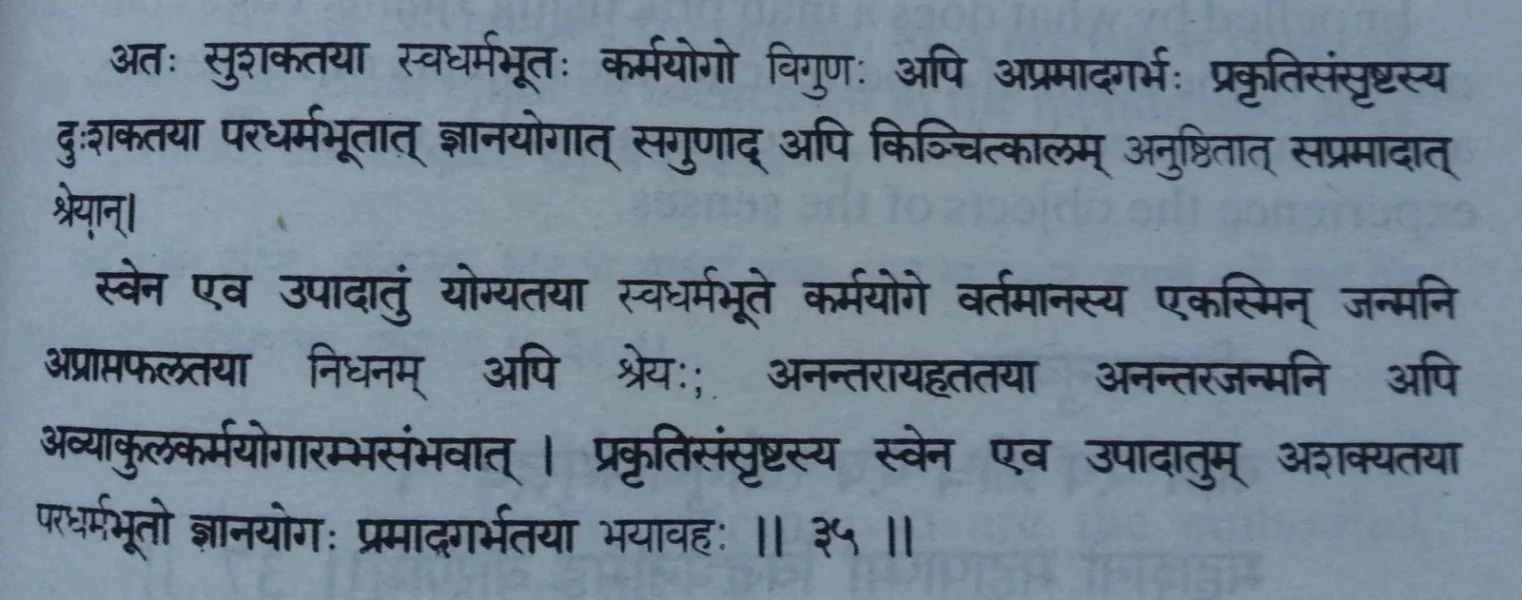
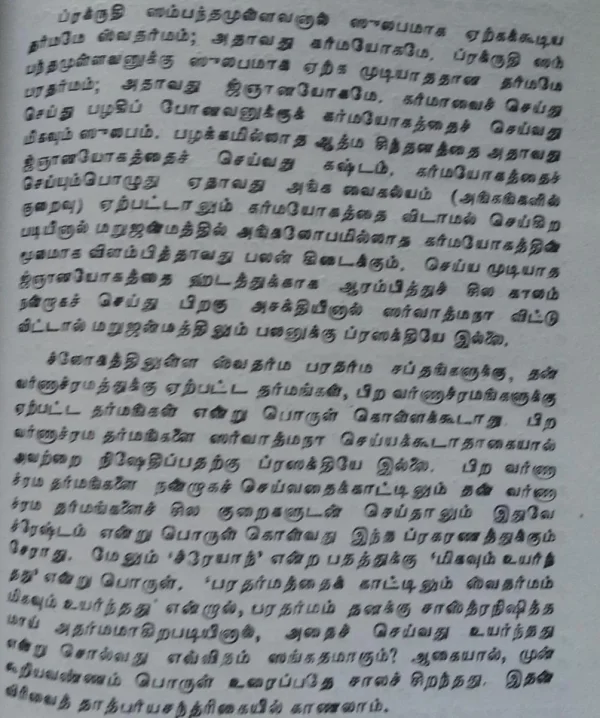
Renuka, I now see the source of confusion. What Ramanuja says is the reverse, i.e. Karma Yoga = one's own Dharma and Jnana Yoga = another's dharma, i.e. those who are qualified for it. The way you have stated suggests doing another's dharma is jnana yoga, which makes no sense at all. Ramanuja's take on this verse is that for ordinary people karma yoga is better than jnana yoga, that is his point.
I have attached two jpgs that further explain this.
....
That book also included the commentary of Ramanuja where he defined:
Own Dharma = Karma Yoga
Another's Dharma =Jnana Yoga.
From post #230:
I did not email Samskrita Bharati New Delhi yet but I managed to find this online about Ramanuja's commentary on One's own Dharma = Karma Yoga and Anothers Dharma = Jnana Yoga
[...]
Therefore Karma Yoga [one’s own natural duty] is better than Jñāna Yoga [the duty of
another].
Renuka, I now see the source of confusion. What Ramanuja says is the reverse, i.e. Karma Yoga = one's own Dharma and Jnana Yoga = another's dharma, i.e. those who are qualified for it. The way you have stated suggests doing another's dharma is jnana yoga, which makes no sense at all. Ramanuja's take on this verse is that for ordinary people karma yoga is better than jnana yoga, that is his point.
I have attached two jpgs that further explain this.
Attachments
OP
OP
Sutra 3
English Translation of the Sutra: The scripture being the means of right knowledge i.e., brahman is cognizable only through the scriptures
Since brahman has no form it cannot be established by direct perception. It cannot be established by inference because of the absence of inseparable characteristics, as smoke is of fire. So it cannot be established by inference or analogy. Thus scriptures is the only source of knowledge that can establish brahman though other means of knowledge can supplement that knowledge.
English Translation of the Sutra: The scripture being the means of right knowledge i.e., brahman is cognizable only through the scriptures
Since brahman has no form it cannot be established by direct perception. It cannot be established by inference because of the absence of inseparable characteristics, as smoke is of fire. So it cannot be established by inference or analogy. Thus scriptures is the only source of knowledge that can establish brahman though other means of knowledge can supplement that knowledge.
From post #85
From post #230:
Renuka, I now see the source of confusion. What Ramanuja says is the reverse, i.e. Karma Yoga = one's own Dharma and Jnana Yoga = another's dharma, i.e. those who are qualified for it. The way you have stated suggests doing another's dharma is jnana yoga, which makes no sense at all. Ramanuja's take on this verse is that for ordinary people karma yoga is better than jnana yoga, that is his point.
I have attached two jpgs that further explain this.
Dear Naraji,
Thanks.
May be I will email Samskrita Bharati and ask them to print the whole explanation cos they only stated Own Dharma =Karma Yoga.
Another's Dharma = Jnana Yoga and did not give any further elaboration.
Last edited:
N
Nara
Guest
Precisely, this is the reason the whole edifice of Vedanta is based on nothing but blind faith that the scriptures present valid knowledge. There is no rational basis for such a faith. At least the great Acharyas were honest, they conceded this point.Sutra 3
English Translation of the Sutra: The scripture being the means of right knowledge i.e., brahman is cognizable only through the scriptures
OP
OP
Precisely, this is the reason the whole edifice of Vedanta is based on nothing but blind faith that the scriptures present valid knowledge. There is no rational basis for such a faith. At least the great Acharyas were honest, they conceded this point.
No Shri Nara, you misunderstand I think. What you call as the only source of knowledge i.e., reason is only one source of knowledge for them. I think they are right and I think that is where the difference is.
Dear Sravna, Greetings.
I refer to your message in post #209, please.
Knowledge acquired by intuition sometimes could be the least reliable since often times it can't be empirically verified or reasonably justified. A person with good strength of intelligence would not present any information sourced by intuition as 'knowledge' but present it as 'hypothesis' or 'opinions'.
Scriptures share only point of views of the author. They can not be taken as the ultimate authority. After analysing Brahma Sutra, one Acharya came to the conclusion of 'Dwaitha' philosophy while one more Acharya after analysing the very same Brahma Sutra, came to the coclusion of 'Advaitha' philosophy. I don't know about you, but this alone tells me Scriptures may not be taken as the ultimate authority.
Actually we don't know the intellectual capacity of the authors of many of the scriptures. Sure, in my opinion, all those philosophies are worth analysing through discussions but not to be accepted with blind faith.
Both the sentences are contradicting each other. The first sentence says it is okay to accept something on faith while the second sentence says not to accept anything on faith alone. Way above my head!
( By the way, have you considered there may be members who would be interested in this thread without participating in the discussion?).
Cheers!
I refer to your message in post #209, please.
Knowledge acquired by intuition is the most reliable source of knowledge in my view though the reliability depends on the strength of the intellect of the person acquiring it.
Knowledge acquired by intuition sometimes could be the least reliable since often times it can't be empirically verified or reasonably justified. A person with good strength of intelligence would not present any information sourced by intuition as 'knowledge' but present it as 'hypothesis' or 'opinions'.
The knowledge revealed by scriptures is to be taken as the ultimate authority because they are acquired by direct intuition and in such a knowledge there is an inbuilt consistency and so the truth of all that is acquired.
Scriptures share only point of views of the author. They can not be taken as the ultimate authority. After analysing Brahma Sutra, one Acharya came to the conclusion of 'Dwaitha' philosophy while one more Acharya after analysing the very same Brahma Sutra, came to the coclusion of 'Advaitha' philosophy. I don't know about you, but this alone tells me Scriptures may not be taken as the ultimate authority.
We know how formidable is the intellect of the people who developed the vedanta philosophies and so cannot dismiss their intuition lightly.
Actually we don't know the intellectual capacity of the authors of many of the scriptures. Sure, in my opinion, all those philosophies are worth analysing through discussions but not to be accepted with blind faith.
So accepting something on faith by itself is ok if what is accepted comes from venerable people. It is also true that vedanta does not ask us to accept what it says only on faith.
Both the sentences are contradicting each other. The first sentence says it is okay to accept something on faith while the second sentence says not to accept anything on faith alone. Way above my head!
( By the way, have you considered there may be members who would be interested in this thread without participating in the discussion?).
Cheers!
OP
OP
Dear Shri Raghy,
You assume that intuition has to be empirically verified to be accepted as knowledge. Need not be. If you accept direct perception something that your senses see as a proof why not something which a mind sees as a proof. Since ultimately it is what the mind sees, what it sees in my view is superior and to be accepted as the authority even if it cannot be empirically verified. This when it comes from a reputable source.
Again you assume all three are equally valid. They really may be mainly because they are the same in essence in my view but differ on non substantive points. Even if they are not equally valid , it doesn't reduce the stature of any one of them as all are a display of formidable reasoning and hence the authors deserve the credit and the following that they have.
No, No not contradicting. I did not say it is ok to accept on faith only but accepting on faith is ok if what you accept comes from a highly regarded person.
Yes I understand. That is the reason I have decided to continue.
Knowledge acquired by intuition sometimes could be the least reliable since often times it can't be empirically verified or reasonably justified. A person with good strength of intelligence would not present any information sourced by intuition as 'knowledge' but present it as 'hypothesis' or 'opinions'.
You assume that intuition has to be empirically verified to be accepted as knowledge. Need not be. If you accept direct perception something that your senses see as a proof why not something which a mind sees as a proof. Since ultimately it is what the mind sees, what it sees in my view is superior and to be accepted as the authority even if it cannot be empirically verified. This when it comes from a reputable source.
Scriptures share only point of views of the author. They can not be taken as the ultimate authority. After analysing Brahma Sutra, one Acharya came to the conclusion of 'Dwaitha' philosophy while one more Acharya after analysing the very same Brahma Sutra, came to the coclusion of 'Advaitha' philosophy. I don't know about you, but this alone tells me Scriptures may not be taken as the ultimate authority.
Again you assume all three are equally valid. They really may be mainly because they are the same in essence in my view but differ on non substantive points. Even if they are not equally valid , it doesn't reduce the stature of any one of them as all are a display of formidable reasoning and hence the authors deserve the credit and the following that they have.
Both the sentences are contradicting each other. The first sentence says it is okay to accept something on faith while the second sentence says not to accept anything on faith alone. Way above my head!
No, No not contradicting. I did not say it is ok to accept on faith only but accepting on faith is ok if what you accept comes from a highly regarded person.
( By the way, have you considered there may be members who would be interested in this thread without participating in the discussion?).
Yes I understand. That is the reason I have decided to continue.
Last edited:
You assume that intuition has to be empirically verified to be accepted as knowledge. Need not be. If you accept direct perception something that your senses see as a proof why not something which a mind sees as a proof. Since ultimately it is what the mind sees, what it sees in my view is superior and to be accepted as the authority even if it cannot be empirically verified. This when it comes from a reputable source.
Dear Sravna,
Ok lets get simple...tell me do your eyes see or does your visual centre of the brain see?
Last edited:
OP
OP
Dear Sravna,
Ok lets get simple...tell me do your eyes see or does your visual centre of the brain see?
Dear Renuka,
I think the sense organs are our interface to the external world. They get the information from the external world , do some processing and pass it on to the brain. It is ultimately the brain that makes sense of it. However our sense organs are fully developed for all the humans and so each passes more or less the same information to the brain and all see the physical world in the same way. However it is not the case with the mind. So there are different perspectives. But there indeed should be ones that are well developed. And it is the intuition of these that can be trusted.
Dear Sravna,
According to you..you feel "what the mind sees is superior and be accepted as authority even if it can not be verified"
Ok lets see how this can be disproved.
Remember the "rope in the dark mistaken for a snake" story.
Before that let me explain that there is something called Visual Memory which is like a data base of previous visual experiences in our brain.
Now when a person sees a rope in the dark..becos of the stored data in his Visual Memory, his mind searches for an image which resembles what he sees and since the surrounding is dark.. fear lurks in his mind..so he will be pressing the Control F button of his mind in the fear zone and look for a stored frightful image that matches what he sees..so becos of that he mistakes the rope to be a snake!
When he switches on the light he realizes that it was no snake after all and just a rope.
Going by this itself we can figure out how unreliable the human mind is.
We need to be illuminated from within to get the whole picture of the Truth and that is never going to be through the senses or even the most developed mind.
The question is "How do we see "directly" without going thru the senses or the mind?"
The answer is that He who knows Brahman verily knows..so till then everything is a guessing game!
According to you..you feel "what the mind sees is superior and be accepted as authority even if it can not be verified"
Ok lets see how this can be disproved.
Remember the "rope in the dark mistaken for a snake" story.
Before that let me explain that there is something called Visual Memory which is like a data base of previous visual experiences in our brain.
Now when a person sees a rope in the dark..becos of the stored data in his Visual Memory, his mind searches for an image which resembles what he sees and since the surrounding is dark.. fear lurks in his mind..so he will be pressing the Control F button of his mind in the fear zone and look for a stored frightful image that matches what he sees..so becos of that he mistakes the rope to be a snake!
When he switches on the light he realizes that it was no snake after all and just a rope.
Going by this itself we can figure out how unreliable the human mind is.
We need to be illuminated from within to get the whole picture of the Truth and that is never going to be through the senses or even the most developed mind.
The question is "How do we see "directly" without going thru the senses or the mind?"
The answer is that He who knows Brahman verily knows..so till then everything is a guessing game!
Last edited:
OP
OP
Dear Sravna,
According to you..you feel "what the mind sees is superior and be accepted as authority even if it can not be verified"
Ok lets see how this can be disproved.
Remember the "rope in the dark mistaken for a snake" story.
Before that let me explain that there is something called Visual Memory which is like a data base of previous visual experiences in our brain.
Now when a person sees a rope in the dark..becos of the stored data in his Visual Memory, his mind searches for an image which resembles what he sees and since the surrounding is dark.. fear lurks in his mind..so he will be pressing the Control F button of his mind in the fear zone and look for a stored frightful image that matches what he sees..so becos of that he mistakes the rope to be a snake!
When he switches on the light he realizes that it was no snake after all and just a rope.
Going by this itself we can figure out how unreliable the human mind is.
We need to be illuminated from within to get the whole picture of the Truth and that is never going to be through the senses or even the most developed mind.
The question is "How do we see "directly" without going thru the senses or the mind?"
The answer is that He who knows Brahman verily knows..so till then everything is a guessing game!
Dear Renuka,
I am saying the same thing , about one who verily knows brahman. These people such as Sankara you can trust. There are minds that can immediately see the truth when it is presented. Even minds that do not accept the truth I think are only being adamant in not accepting the truth even though the truth will appeal to them. Such is the nature of reality and the works of those who understand reality appeal to you in a similar way.
Dear Renuka,
I am saying the same thing , about one who verily knows brahman. These people such as Sankara you can trust. There are minds that can immediately see the truth when it is presented. Even minds that do not accept the truth I think are only being adamant in not accepting the truth even though the truth will appeal to them. Such is the nature of reality and the works of those who understand reality appeal to you in a similar way.
Dear Sravna,
No! You did not say the same thing!LOL
You were using the term 'mind' when in reality the mind is totally unreliable!
Intuition still goes through the mind and senses.
If intuition was the gospel truth coming from the so called advanced spiritual Acharyas.. we would not be having so many schools of thoughts.
That only goes to show it was their opinion(matam) which was oriented to time,place and best suited for the people they were dealing with.
Last edited:
Dear Renuka,
These people such as Sankara you can trust. There are minds that can immediately see the truth when it is presented.
Dear Sravna,
Then can we trust Ramanuja who did not go by Advaita??
OP
OP
Dear Sravna,
Then can we trust Ramanuja who did not go by Advaita??
Dear Renuka,
I consider Ramanuja as something of a divine figure just as Sankara and other great seers of the past. Since everything is finally divine play, ultimately with the objective of making people achieve self realization, and also since so much of diversity is there among people being in different stages of evolution, to cater to the demands, as you say of time, place and context divine messages need to sent in different ways to reach all the people. I think that is what is the reason for seemingly different messages conveyed by the great acharyas. In essence they are the same and each exhibits impeccable logic in it s own way.
Dear Renuka,
As far as my understanding goes mind is not totally reliable only for unrealized souls. Not for realized souls.
Dear Sravna,
You have a pre fixed notion about the following:
1)Realized souls
2)Spiritually advanced
3)Developed mind
This is what that makes any debate difficult and at times not within the scope of "logic".
Dear Sravna,
Dont you feel anyone can claim they are spiritually advanced and start preaching?
Just say tomorrow I suddenly get bored with my medical practice and claim to be a realized soul and start an ashram!LOL
How would you know if I am telling the truth or lying?
What are the test we can conduct on a person to know if they are spiritually realized or not?
Dont you feel anyone can claim they are spiritually advanced and start preaching?
Just say tomorrow I suddenly get bored with my medical practice and claim to be a realized soul and start an ashram!LOL
How would you know if I am telling the truth or lying?
What are the test we can conduct on a person to know if they are spiritually realized or not?
- Status
- Not open for further replies.
Similar threads

- Replies
- 10
- Views
- 1K

- Replies
- 3
- Views
- 1K
