
GANESH65
Active member
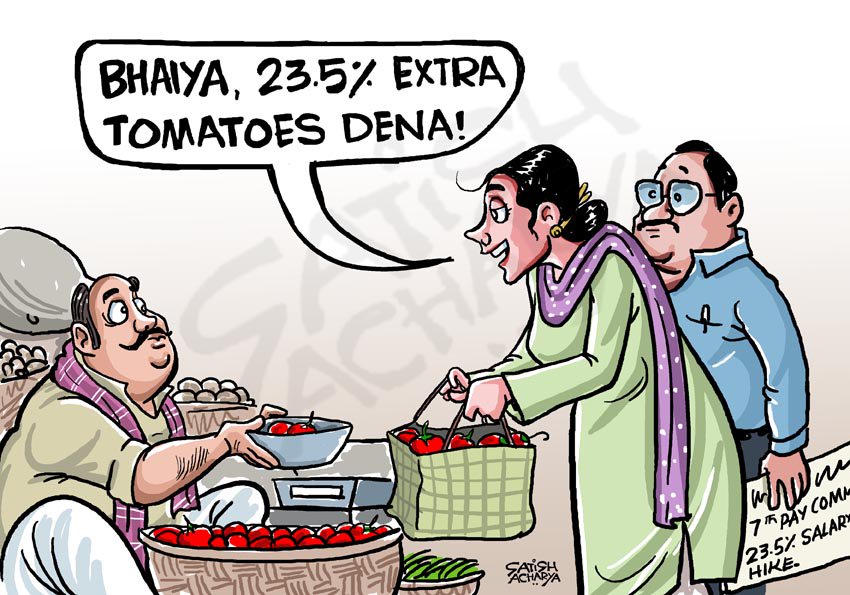
[FONT="]In a move that will benefit nearly one crore central government employees and pensioners, the Union Cabinet Wednesday approved implementation of the 7th Pay Commission which had recommended an overall hike of 23.5 per cent.[/FONT]
[FONT="]The suggestions will be implemented from January 1, 2016. It will cost the government Rs 1.02 lakh crore annually. “I am quite confident that after implementation of the 7th Pay Commission awards, government salaries are distinctively higher than market salaries and private sector salaries,” Finance Minister Arun Jaitley said at a briefing on the Cabinet decisions.[/FONT]
[FONT="]The entry-level pay is being raised to Rs 18,000 per month from the current Rs 7,000 while the maximum pay, drawn by the Cabinet Secretary, has been fixed at Rs 2.5 lakh per month from the current Rs 90,000 — this is in line with the panel’s recommendation.[/FONT]
[FONT="]Jaitley said budget provisions will take care of the hike in salaries suggested by the panel. The government will, in the coming months, examine whether extra resources are needed to be raised from the market to meet these suggestions.[/FONT]
[FONT="]Starting salary of a new employee at the lowest level will now be Rs 18,000 whereas for a freshly recruited Class I officer, it will be Rs 56,100. The government decided to dispense with the present system of Pay Bands and Grade Pay. A new Pay Matrix, as recommended by the commission, has been approved.[/FONT]
[FONT="]7th Pay Commission approved: Key highlights[/FONT]
[FONT="]The gratuity ceiling for employees has been doubled to Rs 20 lakh, while housing loan allowance has been hiked from Rs 7.5 lakh to Rs 25 lakh, Finance Secretary Ashok Lavasa said.[/FONT]
[FONT="]The government has retained four interest-free advances including for medical treatment, tour/transfer, for family of deceased employees and leave travel concession. All other interest-free advances have been abolished.[/FONT]
[FONT="]“The commission examined a total of 196 existing allowances and, by way of rationalisation, recommended abolition of 51 allowances and subsuming of 37 allowances,” the government said. General recommendations of the commission on pension and related benefits have been approved by the Cabinet.[/FONT]
[FONT="]Existing allowances of employees will continue till a government panel takes a call on scrapping many of the allowance as suggested by the panel.
The Cabinet has also decided that arrears of pay and pension benefits will be paid during the current financial year, unlike in the past when parts of arrears were paid in the next financial year.[/FONT]
[FONT="]The recommendations will benefit over 47 lakh central government employees and 53 lakh pensioners, of which 14 lakh employees and 18 lakh pensioners are from the defence forces, the government said.[/FONT]
[FONT="]On administrative reforms suggested by the panel, Lavasa said all such issues, on which suggestions or advice have been given by the commission, are being looked into by the administrative ministries.[/FONT]
[FONT="]Over and above the Rs 1.02 lakh crore of extra financial burden on the government, the implementation will cost an additional Rs 12,133 crore on payment of arrears of pay and pension for two months of 2015-16.[/FONT]
[FONT="]“In the past, employees had to wait for 19 months for implementation of the commission’s recommendations at the time of 5th CPC, and for 32 months at the time of implementation of 6th CPC. However, this time, 7th CPC recommendations are being implemented within 6 months from the due date,” the government said.[/FONT]
[FONT="]Hospital leave, special disability leave and sick leave have been subsumed into a composite new leave named ‘Work Related Illness and Injury Leave’ (WRIIL). Full pay and allowances will be granted to all employees during the entire period of hospitalisation on account of WRIIL.[/FONT]
[FONT="]The government in January set up a panel headed by Cabinet Secretary P K Sinha to process the recommendations of the Seventh Pay Commission.[/FONT]
[FONT="]The Seventh Pay Commission, which submitted its report in November, had recommended an overall 23.6 per cent increase in salaries and pension of central government employees.[/FONT]
[FONT="]Even though the government did not explicitly specify an amount for Pay Commission provisioning in the Union Budget for 2016-17, it had said that an interim allocation for various ministries was made in the budget.[/FONT]
[FONT="]Asked on the likely impact of salary hikes on inflation, Jaitley said some impact on inflation will be natural as more resources are being made available in the hands of the government employees.[/FONT]
[FONT="]The implementation of the Seventh Central Pay Commission awards can push up inflation through direct and indirect channels. The Reserve Bank of India has projected a direct impact of the latest pay commission recommendations on headline inflation to be around 150 basis points, while indirect effects are estimated to be around 40 basis points.[/FONT]
[FONT="]The implementation by the central government will also force states to hikes salaries of their employees. States typically follow the Centre in raising employees’ salaries.[/FONT]
[FONT="]The suggestions will be implemented from January 1, 2016. It will cost the government Rs 1.02 lakh crore annually. “I am quite confident that after implementation of the 7th Pay Commission awards, government salaries are distinctively higher than market salaries and private sector salaries,” Finance Minister Arun Jaitley said at a briefing on the Cabinet decisions.[/FONT]
[FONT="]The entry-level pay is being raised to Rs 18,000 per month from the current Rs 7,000 while the maximum pay, drawn by the Cabinet Secretary, has been fixed at Rs 2.5 lakh per month from the current Rs 90,000 — this is in line with the panel’s recommendation.[/FONT]
[FONT="]Jaitley said budget provisions will take care of the hike in salaries suggested by the panel. The government will, in the coming months, examine whether extra resources are needed to be raised from the market to meet these suggestions.[/FONT]
[FONT="]Starting salary of a new employee at the lowest level will now be Rs 18,000 whereas for a freshly recruited Class I officer, it will be Rs 56,100. The government decided to dispense with the present system of Pay Bands and Grade Pay. A new Pay Matrix, as recommended by the commission, has been approved.[/FONT]
[FONT="]7th Pay Commission approved: Key highlights[/FONT]
[FONT="]The gratuity ceiling for employees has been doubled to Rs 20 lakh, while housing loan allowance has been hiked from Rs 7.5 lakh to Rs 25 lakh, Finance Secretary Ashok Lavasa said.[/FONT]
[FONT="]The government has retained four interest-free advances including for medical treatment, tour/transfer, for family of deceased employees and leave travel concession. All other interest-free advances have been abolished.[/FONT]
[FONT="]“The commission examined a total of 196 existing allowances and, by way of rationalisation, recommended abolition of 51 allowances and subsuming of 37 allowances,” the government said. General recommendations of the commission on pension and related benefits have been approved by the Cabinet.[/FONT]
[FONT="]Existing allowances of employees will continue till a government panel takes a call on scrapping many of the allowance as suggested by the panel.
The Cabinet has also decided that arrears of pay and pension benefits will be paid during the current financial year, unlike in the past when parts of arrears were paid in the next financial year.[/FONT]
[FONT="]The recommendations will benefit over 47 lakh central government employees and 53 lakh pensioners, of which 14 lakh employees and 18 lakh pensioners are from the defence forces, the government said.[/FONT]
[FONT="]On administrative reforms suggested by the panel, Lavasa said all such issues, on which suggestions or advice have been given by the commission, are being looked into by the administrative ministries.[/FONT]
[FONT="]Over and above the Rs 1.02 lakh crore of extra financial burden on the government, the implementation will cost an additional Rs 12,133 crore on payment of arrears of pay and pension for two months of 2015-16.[/FONT]
[FONT="]“In the past, employees had to wait for 19 months for implementation of the commission’s recommendations at the time of 5th CPC, and for 32 months at the time of implementation of 6th CPC. However, this time, 7th CPC recommendations are being implemented within 6 months from the due date,” the government said.[/FONT]
[FONT="]Hospital leave, special disability leave and sick leave have been subsumed into a composite new leave named ‘Work Related Illness and Injury Leave’ (WRIIL). Full pay and allowances will be granted to all employees during the entire period of hospitalisation on account of WRIIL.[/FONT]
[FONT="]The government in January set up a panel headed by Cabinet Secretary P K Sinha to process the recommendations of the Seventh Pay Commission.[/FONT]
[FONT="]The Seventh Pay Commission, which submitted its report in November, had recommended an overall 23.6 per cent increase in salaries and pension of central government employees.[/FONT]
[FONT="]Even though the government did not explicitly specify an amount for Pay Commission provisioning in the Union Budget for 2016-17, it had said that an interim allocation for various ministries was made in the budget.[/FONT]
[FONT="]Asked on the likely impact of salary hikes on inflation, Jaitley said some impact on inflation will be natural as more resources are being made available in the hands of the government employees.[/FONT]
[FONT="]The implementation of the Seventh Central Pay Commission awards can push up inflation through direct and indirect channels. The Reserve Bank of India has projected a direct impact of the latest pay commission recommendations on headline inflation to be around 150 basis points, while indirect effects are estimated to be around 40 basis points.[/FONT]
[FONT="]The implementation by the central government will also force states to hikes salaries of their employees. States typically follow the Centre in raising employees’ salaries.[/FONT]