Nation will come out victorious post-demonetisation: Modi

  • Thread starter Thread starter V.Balasubramani
  • Start date Start date
Status
Not open for further replies.
V

V.Balasubramani

Guest

Let us express our solidarity by being a partner in nation building.

Nation will come out victorious post-demonetisation: Modi


"I have asked for 50 days. It's been just 10 days . the banks will infuse this money in the markets"
The country will emerge victorious after the Centre's demonetisation decision that was a "test by fire", Prime Minister Narendra Modi said on Sunday.

"As I said on the very first day when I announced the decision, it is a time-consuming process. It will cause inconvenience and a little hardship but, I believe, the nation will come out victorious from this test by fire," Modi said at a public rally in the city of the Taj in Uttar Pradesh.

He said his government has been flexible in implementing the demonetisation decision and effected alterations as the need arose.

"I have asked for 50 days. It's been just 10 days and over 5,000 crore rupees have already been deposited in banks... the banks will infuse this money in the markets," he added.

After long queues at banks and automated teller machines for exchanging notes or withdrawing money, Modi had appealed to the public to give him 50 days for the implementation of the demonetisation decision wherein the old Rs 500 and Rs 1,000 currency notes were banned as legal tender effective November 8 midnight.

Modi said he did not take the demonetisation decision to trouble anyone but for the good of the coming generations.

Read more at: http://www.thenewsminute.com/article/nation-will-come-out-victorious-post-demonetisation-modi-53174
 
Last edited by a moderator:
Similar demonetisation of banknote denominations have been taken in the past. In January 1946, banknotes of 1000 and 10000 rupee were withdrawn and new notes of 1000, 5000 and 10000 rupee were introduced in 1954. The Janata Party coalition government had again demonetised banknotes of 1000, 5000 and 10000 rupee on 16 January 1978 as a means to curb counterfeit money and black money.

In 2012, the Central Board of Direct Taxes had recommended against demonetisation, saying in a report that "demonetisation may not be a solution for tackling black money or economy, which is largely held in the form of benami properties, bullion and jewellery".

On 28 October 2016 the total banknotes in circulation in India was ₹17.77 lakh crore (US$260 billion). In terms of value, the annual report of Reserve Bank of India (RBI) of 31 March 2016 stated that total bank notes in circulation valued to ₹16.42 lakh crore (US$240 billion) of which nearly 86% (around ₹14.18 lakh crore (US$210 billion)) was ₹500 and ₹1000 banknotes. In terms of volume, the report stated that 24% (around 22.03 billion) of the total 90266 million banknotes were in circulation.

In the past, the Bharatiya Janata Party (BJP) had strongly opposed demonetisation. BJP spokesperson Meenakshi Lekhi had said in 2014 that "The aam aurats and the aadmis, those who are illiterate and have no access to banking facilities, will be the ones to be hit by such diversionary measures."

If corruption and black money came back with a vengeance after earlier attempts why do you think it will not happen again.
 
Last edited:
Similar demonetisation of banknote denominations have been taken in the past. In January 1946, banknotes of 1000 and 10000 rupee were withdrawn and new notes of 1000, 5000 and 10000 rupee were introduced in 1954. The Janata Party coalition government had again demonetised banknotes of 1000, 5000 and 10000 rupee on 16 January 1978 as a means to curb counterfeit money and black money.

In 2012, the Central Board of Direct Taxes had recommended against demonetisation, saying in a report that "demonetisation may not be a solution for tackling black money or economy, which is largely held in the form of benami properties, bullion and jewellery".

On 28 October 2016 the total banknotes in circulation in India was ₹17.77 lakh crore (US$260 billion). In terms of value, the annual report of Reserve Bank of India (RBI) of 31 March 2016 stated that total bank notes in circulation valued to ₹16.42 lakh crore (US$240 billion) of which nearly 86% (around ₹14.18 lakh crore (US$210 billion)) was ₹500 and ₹1000 banknotes. In terms of volume, the report stated that 24% (around 22.03 billion) of the total 90266 million banknotes were in circulation.

In the past, the Bharatiya Janata Party (BJP) had strongly opposed demonetisation. BJP spokesperson Meenakshi Lekhi had said in 2014 that "The aam aurats and the aadmis, those who are illiterate and have no access to banking facilities, will be the ones to be hit by such diversionary measures."

If corruption and black money came back with a vengeance after earlier attempts why do you think it will not happen again.

In 1978 the demonetization impacted only 2% in circulated value...This time 86%..An impact of himalayan proportion! There cannot be any comparison to the past
 
The aam aadmi putting up with the widespread distress and economic loss caused by declaring invalid all Rs 500 and Rs 1,000 currency notes
+
sees a positive side to the move — it will unearth and stamp out black money. This is one of the stated objectives in the government's notification of November. There is also the target of finishing off fake currency, which harms the economy and is used by terrorists.

With 12 cash-starved days gone, questions are emerging on whether these objectives will be met. And if not, is all this pain for nothing
?​

Although there are no exact figures, estimates for black money range from 20-66% of the GDP. That is, anywhere between Rs 27 lakh crore and Rs 90 lakh crore.

So, is all this going to be unearthed by the present demonetisation?
No, it can't — because not all of this is in cash. According to various past government reports, black money exists in the form of different kinds of assets like benami properties, bullion, shares etc. Then there is one component stashed away in foreign tax havens. Only a fraction of the total black money is hoarded as cash.

There are no estimates for what share of black money exists as illegal cash hoards, says R Ramakumar, dean at Mumbai's Tata Institute of Social Sciences. "Another part of the illegal earnings is seamlessly transferred as capital invested in productive activities," he explained.

A committee on 'Measures to Tackle Black Money in India and Abroad', set up by the finance ministry in 2012 and headed by the chairman of Central Board of Direct Taxes (CBDT) had said that "demonetisation may not be a solution for tackling black money in the economy, which is largely held in the form of benami properties, bullion and jewellery etc."

Recent reports said officials were expecting around Rs 3 lakh crore to remain unreturned to banks by December 30. This is what would be the cash component of black money. All this computation goes to show only one thing — a very large share, in fact the bulk of black money, is not going to be caught in the present drive.
A recent study by the Indian Statistical Institute, Kolkata, carried out under the supervision of the National Investigation Agency with the help of top government economic and intelligence bodies concluded that the total fake currency in circulation in India was Rs 400 crore. This figure was confirmed by minister of state for finance Arjun Meghwal in the Rajya Sabha in August last year.

So, fake notes worth Rs 400 crore will definitely become unusable as a result of demonetisation. But that will last only till the counterfeiters don't print fresh fake currency based on the new notes. Then the whole cycle may start again. In short, the ongoing disruption of daily life across the country is highly unlikely to finish the scourge of either black money or terror funding. Maybe all this pain was in vain.


http://timesofindia.indiatimes.com/...-gain-on-black-money/articleshow/55532113.cms

But the hopeful can always expect miracles. Yes Virginia there is Santa Claus, tooth fairy, ......
 
Last edited:
This message was received on whatsapp. Expresses somewhat similar opinion as post 4 above by Prasadji.

[FONT=wf_segoe-ui_normal]Dr. K.C. Chakrabarty, Deputy Governor of the Reserve Bank of India from 2009 to 2014, is not anti-Modi, anti-BJP person. [/FONT][FONT=wf_segoe-ui_normal]He is explaining in simple, coherent language the social and economic impacts of Demonetization.
Following are the excerpts:[/FONT]

[FONT=wf_segoe-ui_normal]1. The economic benefit is less and the cost is more.
2. I think (the Prime Minister) has not been properly briefed on the subject.
3. Currency notes are not black money, all currency notes are white money.
4. When it (the currency) reaches a person who is not paying tax it becomes black money.
5. When the currency reaches a person who is paying tax it becomes white money.
6. The process and the person are the culprit, but you are destroying the notes.
7. If the process and people are not changed, a person can use currency, gold, other assets for black money generation.
8. Government’s understanding is that [black] money is with the rich, whereas on the contrary more cash money is lying with the poor.
9. 90% of the poor’s liquidity is in cash, so (now) they have no cash.
10. All your trade and commerce is likely to be affected.
11. The total cost of replacing the notes will be Rs 10,000 or 15,000 crore. That is a direct loss.
12. Banks will be doing only this job for the next two months: exchanging the note, managing the cash, managing the crowds. People will be more busy with these things. All this will have an adverse effect on the economy.
13. There will be a liquidity crunch, volume of transactions will go down, sometimes it may totally collapse, depending on the situation.
14. Inflation will come down because people have no money. If you withdraw the money from the people all prices will collapse, but people will not be able to eat vegetables also. Prices are collapsing because medium of exchange is not there.
15. If the economic growth comes down, the government’s tax collection also comes down….If a person goes with black money and spends it in the malls, restaurants or cinema hall then government gets a part of the tax.
16. Demonetisation is a very blunt instrument and it has to be used very judiciously and in a very very critical situation.
[/FONT]

[FONT=wf_segoe-ui_normal]Generally, in a normal situation it doesn’t give any results.[/FONT]
 
[h=1]Demonetisation to have positive impact in long-term, says PNB Housing Finance chief[/h]NEW DELHI, NOVEMBER 20:

PNB Housing Finance Limited (PNBHFL) is quite hopeful of maintaining the first half financial performance in the second half as well,its Managing Director Sanjaya Gupta has said.

The current demonetisation announcement of Rs. 500 and Rs. 1,000 notes is expected to have a beneficial impact on PNBHFL's business and not affect it, Gupta told BusinessLine after the Board considered the company's results for the first half this fiscal.

Financial performance


For the six months ended September 30,2016, PNBHFL reported a net profit of Rs. 233.6 crore, up 75 per cent over net profit of Rs. 133.6 crore recorded in same period last fiscal. Net interest income recorded 45 per cent increase to Rs. 437.6 crore (Rs 301.5 crore). "We are pretty hopeful to maintain the first half bottomline in second half as well. Third quarter--which is important quarter for housing finance industry--will be little dampened as there may be deferment of decision making. But the fourth quarter will be far-far better for us", Gupta said.

Long term positive


Gupta highlighted that demonetisation is a "big positive step" that has happened in Indian economy and would bring lot of transparency in housing finance/real estate industry.

"In the long run, demonetisation is a big positive step. I have been in this industry for 30 years. This is the first time any government has taken such a bold step and holding on to it. They are not relenting on it", he said.

Read more at: http://www.thehindubusinessline.com...-pnb-housing-finance-chief/article9367627.ece
 
Is the country "NOT" victorious today?Country is victorious today and will be victorious everyday.A government does not make the country.India was victorious in 15th, August 1947 and will be.Modi did not make India great. India might become more successful and economically prosperous because of the people.
 
Is the country "NOT" victorious today?Country is victorious today and will be victorious everyday.A government does not make the country.India was victorious in 15th, August 1947 and will be.Modi did not make India great. India might become more successful and economically prosperous because of the people.


One should try to understand the difference between 'Freedom' and 'Victorious'.

It is the people who elect the Government

And it is the people who elected Modi with all faith and trust

And it is the people who support him in all his endeavours towards country's progress in spheres of activity.

And they know that the goal is more important than the path

And they have better judgement as when to show their sdolidarity and when to react with riot.
 
Last edited by a moderator:
Mohanlal blogs praising demonetisation, says larger good justifies temporary setbacks

“The goal is more important than the path.”

Even amidst mounting protests, Prime Minister Narendra Modi’s demonetisation move has found many takers, with South Indian superstar Mohanlal the latest to join the supporting chorus.

In his latest blog-post on Monday, Mohanlal appealed to the people to set aside their temporary difficulties and appreciate the move that is all set to serve a larger cause.

The actor -who is currently in Jaipur for the shoot of his upcoming film directed by Major Ravi- describes the PM’s speech on demonetization as a surgical strike that was carried out with utmost sincerity and dedication.

“I believe that his speech contained elements that proves that he has thoroughly studied the issues faced by the country. I heard our PM say that this was a surgical strike against black money. I am not someone who worships an individual, but I do respect sincere ideas,” he writes.

Mohanlal terms the initial difficulties posed by the move as temporary ones that can be justified with the larger good it will lead to. He cautioned his readers to not treat his words as that of a financial expert, but as from a common man unclouded by prejudice.
He reiterated that the goal justifies the path taken to achieve it. The actor goes on to elaborate on the circumstances that make people part of a corrupt public system.

Read more at: http://www.thenewsminute.com/articl...arger-good-justifies-temporary-setbacks-53215
 
Modi is an honest person trying to achieve some legitimate goals. I admire his sincerity.
He depends on his party people to carry out his policies. The implementation of policy is flawed.
Having said that I am not a Modi apologist.

Just because someone is popular, they may not be right. Please do not jump to the conclusion that I am comparing the two leaders.

Why was Hitler so popular in Germany from 1933 onwards? Hitler became popular in a range of various different ways and clever techniques. A few of these powerful methods were; his use to deliver inspiring speeches, propaganda and deceivingly terror as well (More techniques described later in assessment). He soon had the nation of Germany under his control. Firstly one of the ways Hitler gained popularity was the fact that after the German economy failed during the Great Depression, more people started for Hitler because he promised to change the country. A lot of Germans hated Jews so Hitler also blamed the Jews for losing World War 1, so he promised to get rid of them. He offered them hope and promised to restore Germany's power and excellence. Hitler had a gifted talent of delivering inspiring speeches saying how great Germany was, which gave the Germans a feeling of pride and dignity. Evidence that Hitler gave motivational speeches is in source B, this source stated that his speeches were so powerful, that he compared it to a "religious conversion".
 
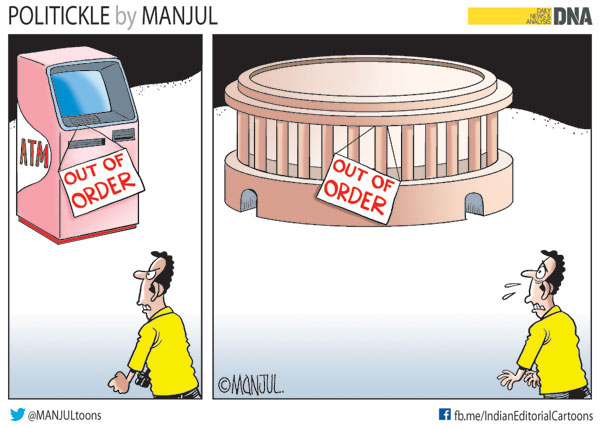
Two weeks after PM Narendra Modi-led Central government announced demonetisation of old higher denomination currency notes, queues outside banks and ATMs have become a usual sight across the country. With a limit on exchange and withdrawal of cash from both banks and ATMs, and shortage of currency notes has led to a chaotic situation. The opposition parties have come together in an attempt to corner BJP government over the issue claiming the lack of planning was creating extreme problems for people.

To verify whether media was spreading lies, a Bengaluru man – Tinu Cherian Abraham – decided to go on an ATM trail on Sunday and shared what he witnessed on micro-blogging platform Twitter. “ATM Trail was an impromptu action for a reality check on the enormity of cash crisis at ATMs as spoken on media – both traditional and social media. Before the note ban, all these ATMs work normally even on Sunday…I wanted to see if it is the same almost 2 weeks after the ban,” he told IndianExpress.com.

Tinu – a social media celebrity – visited 23 ATMs close to his residence starting from HDFC bank’s Kadugodi branch ATM. Abraham managed to check 16 ATMs in the first three hours and found that 13 of them were out of cash. The rest, as he said, were dispensing only Rs 2,000 notes and had long queues outside.

In the next few hours, Tinu visited seven more ATMs before he stopped his trail. Out of these seven, he found that six ATMs were out of cash and the only one working – a Canara bank ATM in KR Puram – was also dispensing only Rs 2,000 notes.

“Scouted all ATMs I could find in 2 areas – so that people don’t assume I cherry picked the ATMs that doesn’t work,” Tinu said.
Banks are in a process of recalibrating all the ATM machines across the country so that they can dispense the new Rs 2000 and Rs 500 notes which have different dimensions compared to previous notes. Some experts suggest that the process might take about three months to complete. Till then, most of the ATMs can only dispense Rs 100 notes, bringing down their storage capability significantly.
http://indianexpress.com/article/tr...lability-of-cash-heres-what-he-found-4390279/

May be he did not visit Vganeji's bank. Or may be he did not have vganeji's affiliation or bias. LOL
 
The topic under consideration (not a burning topic, nor a burning question) is an economic evaluation of the costs and benefits of demonetisation, and how the implementation could have been better. There is no doubt that people, especially the poor and the emerging middle class (bottom two-thirds of the population) have suffered a fair amount of inconvenience in obtaining cash for their daily needs. I doubt if the rest have suffered much at all (unless there were weddings in their families). Could the move have been costless? Absolutely not, and anybody selling you that is also selling you some Rs 1,000 notes. In the future in India, the terms “snake oil” or the “Brooklyn Bridge” will be used to refer to somebody selling a formerly legal Rs1,000 note. (George C. Parker was the greatest con man in American history and sold the Brooklyn Bridge repeatedly, once for $ 50,000. Snake oil recipes were being sold in Spain in the 18th century).
http://indianexpress.com/article/opi...-thud-4383065/
 
Amid millions of people queuing up across the country to exchange defunct Rs 500/1000 notes, RBI on Tuesday asked banks to take stern action against officials indulging in fraudulent practices while exchanging or depositing the invalid currency.
Banks have also been asked to remain prepared to provide details about the notes exchanged or deposited on short notice. The 500 and 1000 rupee Specified Bank Notes (SBNs) have been demonetized from November 9, 2016 in a crack down on black money. "It has been brought to our notice that at certain places, few bank branch officials, in connivance with some miscreants, are indulging in fraudulent practices while exchanging SBNs in cash/accepting SBN deposits into account," said the Reserve Bank of India.

"Banks are, therefore, advised to ensure that such fraudulent practices are stopped forthwith through enhanced vigilance and take stern action against officials involved in such activities," it added. RBI asked banks that they should ensure strict compliance with the instructions issued with regard to exchange of SBNs as also deposit of such notes into the accounts of their customers.
Earlier, the banks were asked to maintain denomination wise details of such notes and aggregate value of non-SBN note deposited in the account of each deposit or loan customer from November 9, 2016 onwards. They have to also maintain customer-wise and denomination wise record in respect of SBNs exchanged by walk-in and regular customers. Banks should also be in readiness to provide these details at short notice, RBI said. Meanwhile, as many as 82,500 ATMs, which account for about 40 per cent of cash vending machines in the country, have been re-calibrated to dispense new high security currency notes of 500 and 2,000 rupees. Out of 2.2 lakh ATMs, 82,500 had been re-calibrated till last evening.
http://www.dnaindia.com/money/repor...ulently-exchanging-notes-rbi-to-banks-2276001
 
521670-pol.jpg
 
Who were the men and women Prime Minister Narendra Modi consulted before banning the big notes?
The answer to that question is hard to find, but Business Standard spoke to bureaucrats and politicians to piece together what went behind the decision of November 8.
Bureaucrats hardly spoke initially, but as queues got longer outside banks and ATMs went cashless, there were murmurs in the corridors of power that demonetisation was executed without much thought to details.
Some officials, who were now firefighting, confided in whispers that they were not kept in the loop.
A source told Business Standard that bureaucrats have now started sharing pre-demonetisation anecdotes, fearing that they may be held responsible by the political leadership for poor execution.
Those with their ear to the ground even pointed to the "subterranean propaganda" by the government's supporters of how the bureaucracy sabotaged the PM's plan.
A senior bureaucrat, who was part of the November 8 Cabinet meeting, which approved the decision to demonetise, said little consultation took place.
"The plan was already in place. We were called to be apprised about it," a secretary of a key department, requesting anonymity, said.
Last week, Power Minister Piyush Goyal told the Rajya Sabha that the Reserve Bank of India Board of Governors took the decision, Cabinet approved it and the PM announced it.
But those in the know claimed that the slot for the PM's speech, telecast at 8 pm on state broadcaster Doordarshan, had already been booked by the time the formal Cabinet meeting started around 6.30 pm.
"A bit of foresight would have helped. Isn't it common sense that this is sowing and wedding season? The plan is indeed unquestionably revolutionary, but better preparedness could have avoided such teething troubles," said an IAS officer in a core economy department.

The decision was a bolt from the blue for most ministers as well.
Janata Dal-United leader Sharad Yadav told the Rajya Sabha that Finance Minister Arun Jaitley was made aware of the decision at a very late stage.

'If you knew, you would have surely advised against it,' Yadav said. Jaitley permitted himself a smile, but didn't get up to correct his 'old friend.'

However, finance ministry bureaucrats maintained that much planning, and even consultations, were carried out.
But they admitted that the number of "money mules" or "surrogates" was not accounted for.
Another gap in planning was that nobody thought acceptance of new Rs 2,000 notes would be a problem.
When the plan was being deliberated upon, all stakeholders involved were in agreement that a higher denomination note was needed, another source said.

"The RBI is known to have proposed Rs 2,000, Rs 5,000 or Rs 10,000 denominated notes. There is now an acknowledgement that a decision was reached without considering how the new notes would be accepted by people."
There's much talk on the role played by the central bank as well.
Officials pointed out that RBI Governor Urjit Patel should have provided realistic assessments on how this plan should be carried out, especially since it has all the data it needs regarding the rural and urban distribution of banks and ATMs and the printing capacity at mints around the country.

Questions are also being asked as to why only Economic Affairs Secretary Shaktikanta Das has been given the responsibility of interacting with the media, and through it to the larger public.
And why has not much been heard from other senior planners, including Finance Secretary Ashok Lavasa, Financial Services Secretary Anjuly Chib Duggal and indeed RBI Governor Patel?
http://www.rediff.com/business/report/demonetisation-who-knew-who-didnt/20161122.htm

 
Status
Not open for further replies.
Back
Top